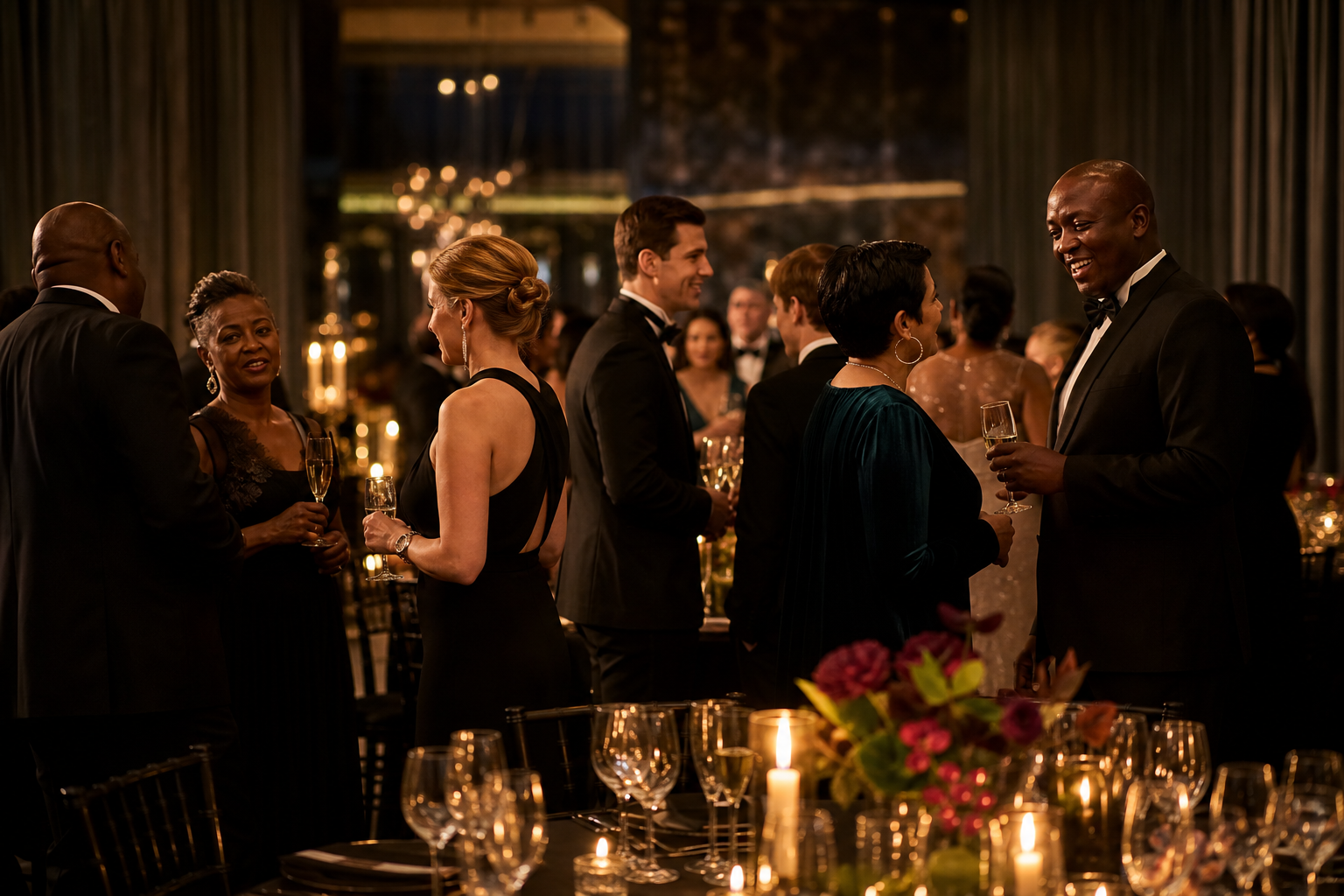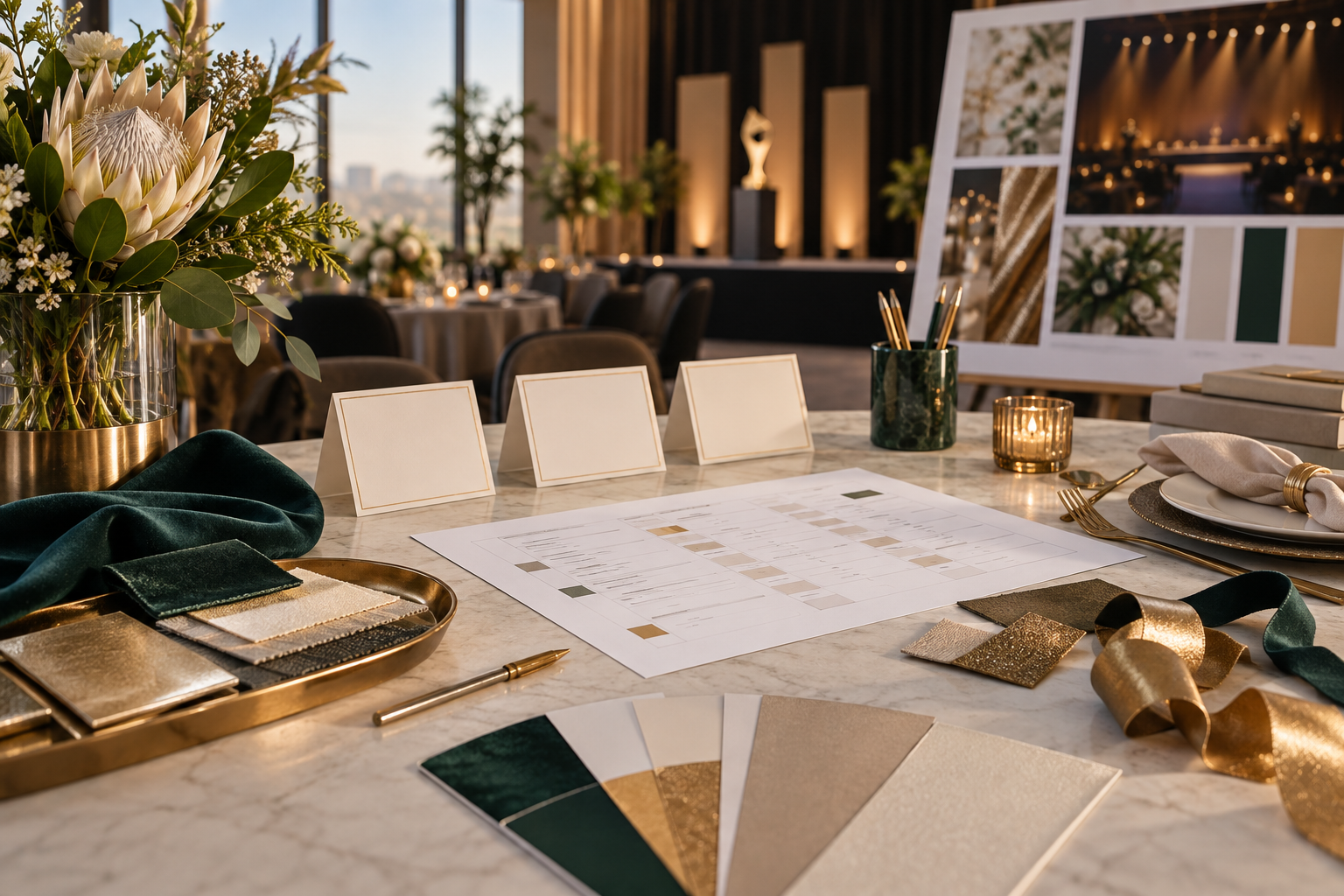
Choosing awards ceremony theme ideas for work events is easier when a theme is treated as a decision about recognition, not just a decoration package. Start with what the organisation wants people to remember, then choose visual language that supports the room, the running order and the way guests take part.
This guide is for planners who already know there will be an awards moment but still need to settle the concept around it. For the recognition format, category design and programme structure, use our guide to awards ceremony ideas for work events first. Then use the framework below to turn the chosen direction into a theme a venue and suppliers can actually deliver.
Start with the recognition story
Before collecting mood-board images, finish this sentence:
“Tonight we are recognising people for ______, and we want the room to feel ______.”
The first blank might be measurable results, collaboration, customer care, learning, leadership or a contribution that is easy to overlook. The second might be assured, warm, elevated, energetic or reflective. Those two decisions narrow the theme more usefully than a list of colours.
| Recognition story | Theme direction to explore | What it should change in the room |
|---|---|---|
| A formal celebration of standout achievement | Polished awards night | Clear stage hierarchy, deliberate transitions and a restrained visual system |
| A year of progress and shared milestones | Company story in chapters | Timeline cues, selected moments on screen and a programme that moves through the story |
| Individual talent and personal contribution | Studio or profile night | Strong portrait language, presenter preparation and room for people to be seen |
| Learning, innovation or a new chapter | Future-facing working session | Simple graphic cues, purposeful lighting and a confident but readable stage |
| Appreciation, belonging and team habits | Warm team celebration | Softer arrival cues, inclusive participation and a pace that leaves room to connect |
These are starting directions, not fixed packages. The useful question is whether the direction makes the reason for the ceremony clearer.
Use a four-part theme test
Run every shortlisted idea through the same test before presenting it for approval.
1. Does it make the award story easier to understand?
The theme should support the language used in nominations, citations and presenter notes. A concept built around progress can help the programme move from the year’s challenge to the people who changed the result. A formal gala direction may be better when the event needs a concise, high-attention celebration. If the theme needs a long explanation before anyone can picture it, simplify it.
2. Can guests participate without guessing what to do?
Theme cues should give guests an easy role: a prompt on arrival, a message wall, a short vote, a dress direction or a place to share a story. Keep participation optional and place it in an arrival or social window when the event has a formal stage programme. The awards evening entertainment guide can help place extra energy without interrupting the important recognition moments.
3. Does it survive the venue?
Check sightlines, ceiling height, loading rules, power, noise limits, table layout, accessibility and the distance between arrival, dining and stage areas. A theme that depends on a large scenic installation may not be the best choice in a room with a tight build window. A strong concept can often be expressed through a small set of repeatable cues: one palette, one material, one lighting idea and one phrase.
4. Can the programme carry it?
The theme should appear in the opening, category transitions, presenter prompts and close without turning every award into a production number. Confirm where meals, speeches, entertainment, photographs and networking sit in the running order. Use the corporate event planning timeline to give the theme decision a clear approval point before suppliers begin detailed work.
Five theme directions that work for workplace awards
Polished awards night
Choose this when the organisation wants a clear, formal moment of recognition. Keep the palette narrow, let the stage do the work and make each category easy to follow. A polished direction can still feel current when the team chooses one distinctive material or lighting cue instead of layering on more décor.
Watch for: a room that looks impressive in photographs but makes citations hard to hear, winners hard to see or the programme hard to follow.
Company story in chapters
Choose this when the ceremony should connect awards to a year of progress. Organise the evening into a few meaningful chapters rather than trying to show every milestone. The visual system can repeat a small set of chapter markers across the invitation, screen content, table details and presenter notes.
Watch for: a timeline that becomes a long corporate presentation. Keep the recognition of people at the centre of each chapter.
Studio or profile night
Choose this when the event is about the people behind the work and the organisation wants a more personal visual language. Use considered portrait direction, short human citations and a clean place for presenters to introduce the context behind an award.
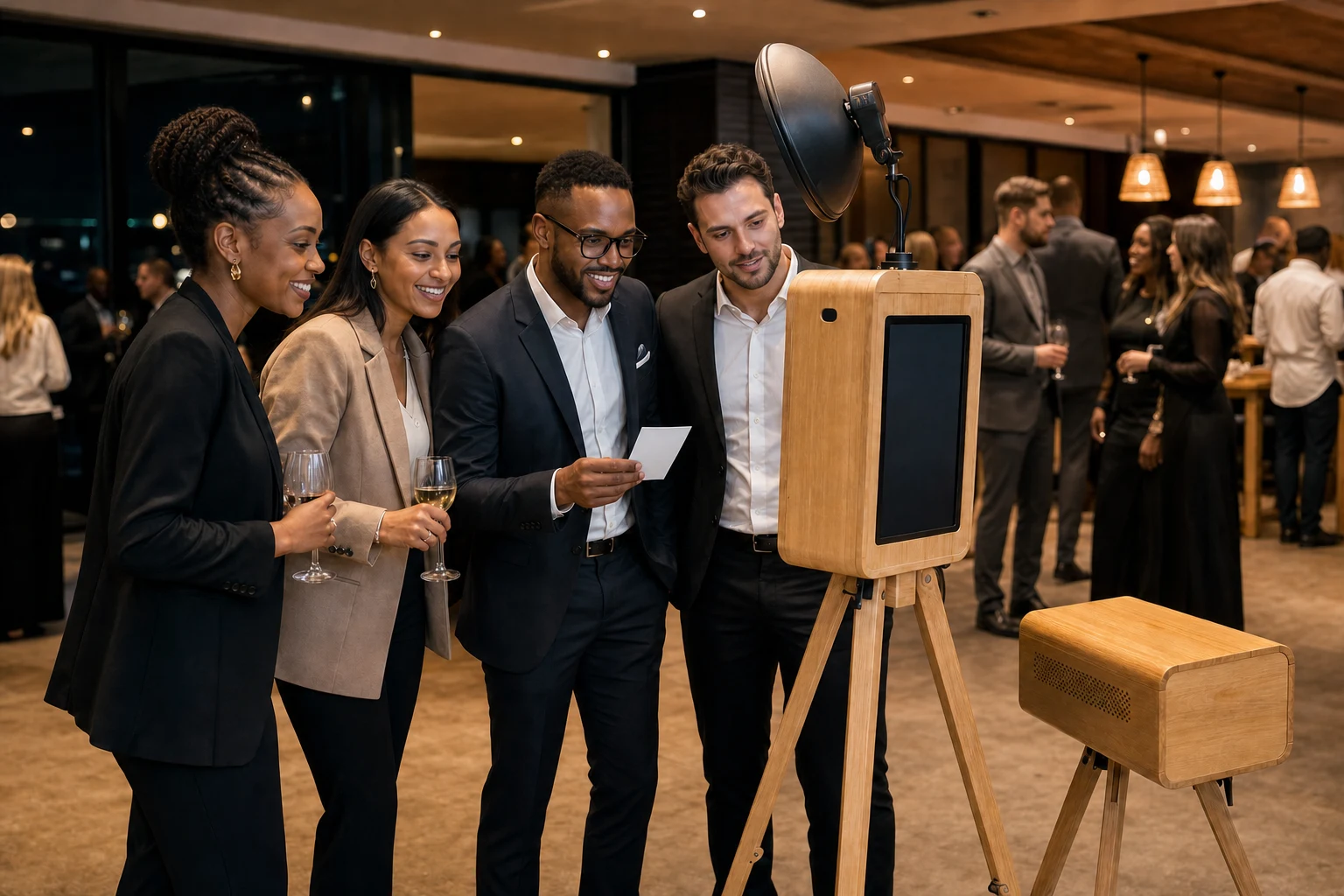
If an optional hosted portrait experience is part of the brief, position it in an arrival, social or post-formal window. Guests can choose an available style on the portrait-oriented front screen, face the front camera and move to the larger rear screen to review the result. Confirm the exact style direction, operating window and agreed output with the event team; the corporate AI photo booth service can be assessed alongside the rest of the supplier brief.
Watch for: making the portrait activity feel compulsory or placing it beside the stage during presentations.
Future-facing working session
Choose this when the organisation wants to celebrate innovation, learning or a new phase. Keep the concept legible: a small number of graphic shapes, a controlled light treatment and language that still sounds like the company. The theme should feel optimistic without requiring a technology spectacle.
Watch for: visual effects that compete with faces, award names or captions on screen.
Warm team celebration
Choose this when the evening needs to feel generous, inclusive and easy to join. Use welcoming arrival cues, short recognition blocks and a social reset between formal moments. The theme can be expressed through colour, texture, music and food choices without requiring a stage-heavy build.
Watch for: a casual atmosphere that makes the awards feel like an afterthought. Keep the criteria and citations specific.
Carry the theme through the whole guest experience
A theme feels intentional when the same decision appears in the places guests actually notice.
- Before the event: use the invitation, RSVP wording and dress guidance to set the level of formality without making the brief mysterious.
- On arrival: give guests one clear cue, such as a short prompt, a story card or a message to the nominees.
- In the room: repeat the palette, material or graphic language across the stage, table details, screens and directional signs.
- In the programme: let the opening, category transitions and close use the same vocabulary as the theme.
- Around the formal moments: place entertainment, portraits and networking in planned windows that protect the citations and presentations.
- At the end: choose a takeaway, photo treatment or closing message that reinforces the recognition story rather than adding another unrelated motif.
The theme does not need to appear everywhere. It needs to appear consistently where a guest makes a decision or looks for meaning.
Turn the decision into a one-page supplier brief
Once the shortlist is approved, write the brief before requesting detailed concepts. Include:
- Purpose: what the ceremony is recognising and what guests should feel.
- Audience: who is attending, how formal the evening is and any accessibility considerations.
- Theme sentence: the chosen direction in one line, plus three visual or tonal cues.
- Venue reality: room plan, stage position, arrival flow, ceiling or loading constraints and venue rules.
- Programme windows: awards blocks, meals, speeches, entertainment, portraits and networking.
- Guest role: what people may do on arrival or between formal moments, and what remains optional.
- Supplier outputs: décor, screen content, print pieces, host support, portrait or print requirements and digital handoff.
- Boundaries: elements to avoid, approval owners, budget assumptions and the date by which changes stop.
This brief gives décor, production, entertainment and portrait suppliers the same source of truth. It also makes it easier to remove an attractive idea that does not serve the recognition story.
Final approval checklist
Before the invitations or supplier orders are locked, ask:
- Can the theme be explained in one sentence without a mood board?
- Does it make the award criteria and citations easier to understand?
- Can guests tell what participation is optional and when it happens?
- Are names, faces, screens, stage sightlines and sound protected?
- Does the venue support the physical version of the concept?
- Do entertainment and portrait activity have a defined window and location?
- Can every supplier describe the same palette, tone and must-have outputs?
- Is there a clear owner for final creative approval?
If the answer is yes, the event has more than a décor idea: it has a usable theme decision. For a South African workplace event, the final brief should still be checked against the actual venue, programme, supplier scope and guest needs. Start the event conversation when you are ready to turn that brief into a considered hosted experience.